


Pakistan’s Fiscal Problem (Part II): The Cost of Not Fixing Procurement
Pakistan's Fiscal Problem (Part II): The Cost of Not Fixing Procurement
Pakistan's fiscal problem goes beyond the major cost centres of government – that is, it is not just about salaries and pensions. Beyond the question of what we spend on is the question of how we think about spending. In a word: procurement.
Fiscal fixes in the public sector salary bill and in pensions are politically challenging. Public servants will not see kindly to changes in the salary structure that result in savings. They will see even less kindly to any sort of effort to significantly reduce the size of government, because that would mean firing people. Similarly, pension reform that produces fiscal savings today would require shifting existing employees to a financed pension plan and pension contributions, which would be equally unpopular.
Procurement reform across sectors, and across national and provincial governments, is the other major opportunity through which there can be real fiscal savings. A large part of the federal and provincial budgets, both current and development, end up being used in some form of procurement process or the other. From vehicles to planes, medicines and vaccines to IT systems, fuel supplies to office goods, insurance to civil works contracts, and even the procurement of HR and the outsourcing of services, the real fiscal question is not just a question of how much our governments spend, it is how intelligently they buy. The good news, as this article explains, is that improving procurement can produce a significant upside.
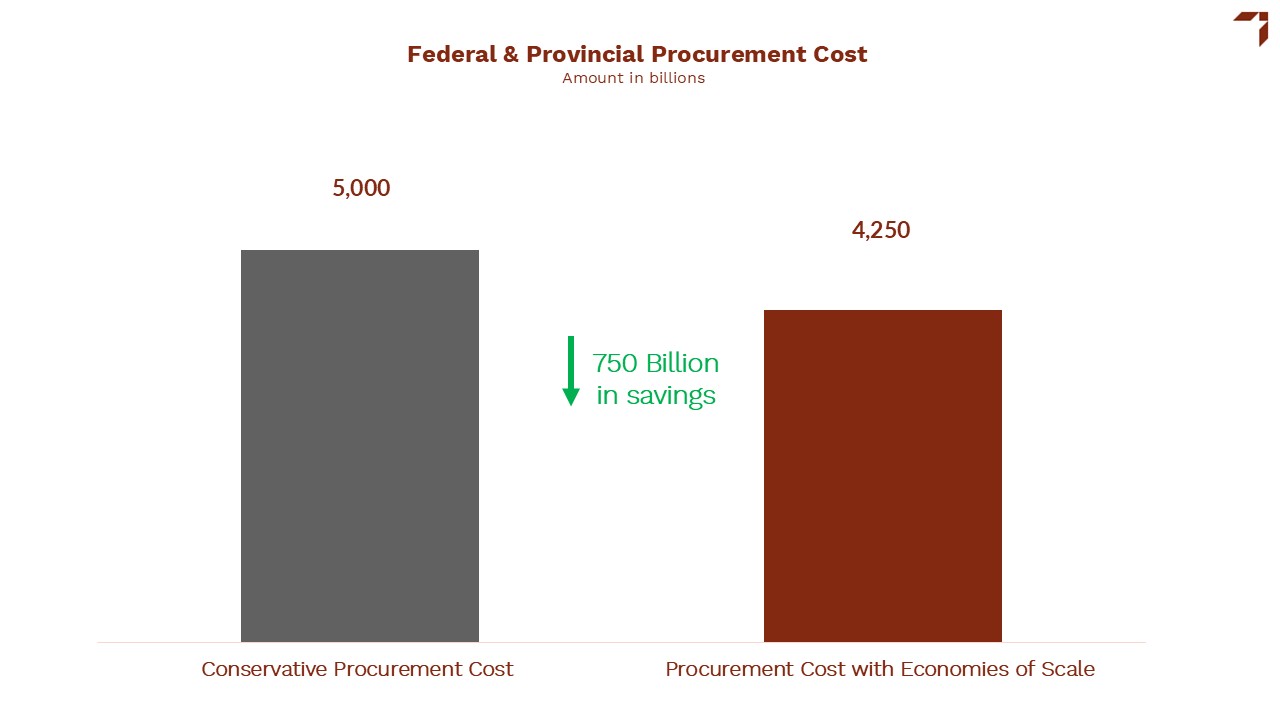
Research shows that public procurement amounts to 12% to 15% of GDP in developed economies, typically more in developing countries. As a percentage of budget spend, the OECD averages 30% of total government spending on procurement, with spending in developing countries being typically significantly higher (OECD report – Government at a glance 2025). Even the most conservative estimates for Pakistan therefore, assuming 20% of government expenditure is spent on procurement, significantly less than the global average, would mean that between the federal government (total spending of Rs 17 trillion) and provincial governments (total spending of over Rs 8 trillion), procurement spend exceeds Rs 5 trillion. When the state procures at this scale, even modest inefficiencies translate into enormous fiscal losses.
Research is also clear that public procurement systems frequently generate significant waste. A detailed study of Italian public bodies finds large price variation for identical goods across agencies, with most of the waste attributed not to corruption but to inefficient purchasing practices and weak incentives (Bandiera, Prat & Valletti, 2009). The implication is clear. Poor procurement design leads to systematic overpayment.
The impact of good procurement reform is also clear. A World Bank review of procurement reforms finds that centralized procurement and framework agreements have delivered substantial savings in multiple countries, with well-implemented reforms often reducing prices by 5 to 10 percent and in some cases much more (Fazekas & Blum, 2021). OECD evidence similarly shows that aggregating demand and using framework contracts strengthens bargaining power and lowers prices (OECD, 2016).
These are not minor administrative tweaks. Because governments typically spend 12 to 15 percent of GDP through procurement channels, even small percentage savings across that base generate significant fiscal space (Fazekas & Blum, 2021).
Pakistan's procurement system remains highly fragmented. Ministries and attached departments purchase similar goods independently. One department buys vehicles at one price. Another buys comparable vehicles at a higher price. Large hospitals procure medicines separately. Universities, agencies and government departments buy computers and IT equipment independently. Offices repeatedly purchase furniture and stationery without pooling demand.
No large private corporation would operate this way. When purchases are fragmented, volumes are smaller and negotiating power weakens. Suppliers can charge different prices across departments. When demand is aggregated, economies of scale emerge. Bulk purchasing allows the government to negotiate lower unit prices, standardize specifications and reduce transaction costs.
If the federal government consolidated procurement for high-volume goods such as vehicles, fuel, medicines, IT equipment and office supplies, it would significantly strengthen its bargaining position. Volume discounts alone can generate measurable savings, as documented in OECD countries (OECD, 2016). A federal framework contract system would allow ministries to purchase from pre-negotiated agreements instead of conducting repetitive tenders for identical items.
Procurement rules must also shift from procedural compliance to value for money. The lowest initial bid is not always the cheapest contract over time. Poor quality leads to delays, renegotiations and maintenance costs. International best practice increasingly uses life cycle costing and quality-based evaluation to reduce total project costs (Fazekas & Blum, 2021).
Transparency and benchmarking also matter. A centralized database of historical prices and supplier performance would allow procurement officials to compare bids against established norms. Countries that have implemented price benchmarking systems report reductions in overpricing and improved contract outcomes (OECD, 2016).
Finally, procurement must be professionalized. Training officials, standardizing bidding documents and strengthening post-award audits reduce waste and improve outcomes. Governance improvements in procurement are consistently associated with better spending efficiency (Fazekas & Blum, 2021).
The fiscal arithmetic is straightforward. If procurement spend across Pakistan (including both the federal and provincial governments) is estimated at Rs. 5 trillion annually, even a 10 percent efficiency gain would yield around Rs. 500 billion in savings. At 15 percent, savings approach Rs. 750 billion. Effectively, this would equal increasing the federal development budget by 50% to 75%.
Pakistan does not need blunt austerity to reduce expenditure. It needs smarter purchasing. When the government is one of the largest buyers in the economy, procurement reform is not a technical adjustment. It is one of the most powerful fiscal reforms available.
References
Bandiera, O., Prat, A., & Valletti, T. (2009). Active and Passive Waste in Government Spending. American Economic Review, 99(4), 1278–1308. https://www.cerp.org.pk/wp-content/uploads/2023/06/Bandiera-et-al-2017-final-report_1.pdf
Fazekas, M., & Blum, J. R. (2021). Improving Public Procurement Outcomes: Review of Tools and the State of the Evidence Base (Policy Research Working Paper No. 9690). World Bank Group. https://documents1.worldbank.org/curated/en/656521623167062285/pdf/Improving-Public-Procurement-Outcomes-Review-of-Tools-and-the-State-of-the-Evidence-Base.pdf
Organisation for Economic Co-operation and Development (OECD). (2016). Public Procurement for Sustainable and Inclusive Growth. OECD Publishing. https://www.ospi.es/images/documentos/archivos/Public_Procurement.pdf
